
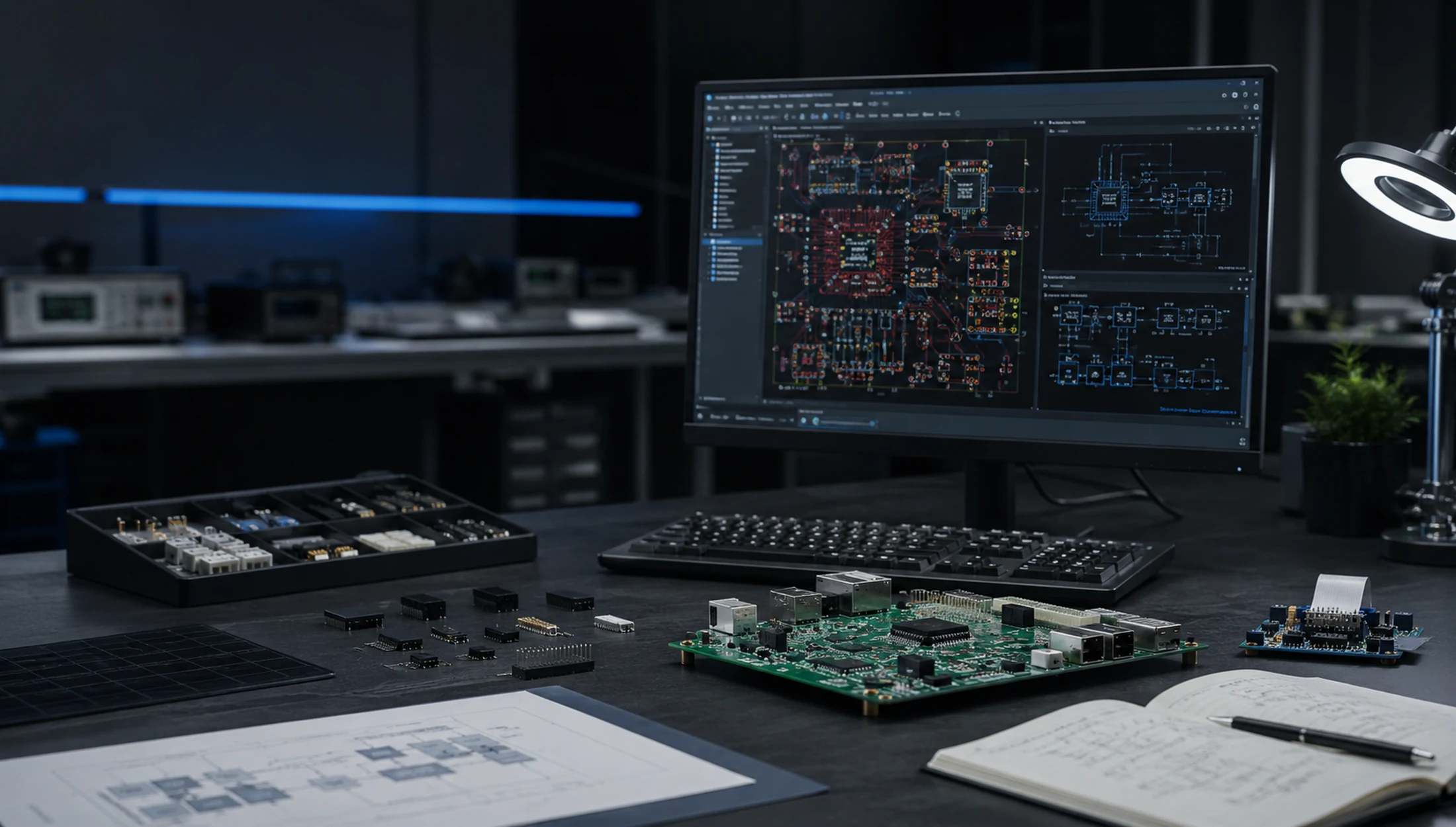
electronics modernization

Electronics modernization and redesign of existing products

We update existing electronics to resolve reliability, availability, interface or production problems while preserving the product functions that must remain unchanged.

Electronics modernization and redesign on an engineering workbench

You can start with a practical problem

You do not need to prepare formal engineering terminology before contacting us. A clear business or equipment problem is enough for an initial technical discussion.

What we do

AssessExisting design files, samples, failures and required unchanged behavior.
DiagnoseRoot causes in power, signals, layout, software or component selection.
PlanDefine the revision scope and regression criteria.
RedesignUpdate hardware and firmware in controlled increments.
PrototypeBring up the new revision and compare against baseline behavior.
ReleaseUpdate source and manufacturing documentation.

What the customer receives

The exact deliverable set is agreed before the stage starts so acceptance is based on concrete engineering results rather than activity.

Engineering change scopeUpdated schematics/PCBFirmware changes where requiredPrototype verification reportUpdated production package

Technology and implementation

We select the architecture and tools according to interfaces, timing, environment, maintainability and production constraints.

Power and protectionImprove margins, transient protection and component derating.
InterfacesUpdate transceivers, isolation, connectors or signal conditioning.
PCB revisionCorrect layout, thermal or EMC-related weaknesses.
FirmwareStabilize drivers, timing, diagnostics and update logic.
ComponentsReplace obsolete parts and document alternatives.
RegressionVerify preserved functions after every material change.

Electronics modernization and redesign of existing products: engineering approach

Modernization starts by separating the functions that must remain compatible from the parts of the design that can be changed. This keeps the project focused and makes regression testing possible.

Where the original documentation is incomplete, reverse engineering can be used to establish the actual implementation before redesign.

The final revision is delivered with updated source and manufacturing materials so the improvement is maintainable.

01

Current-state assessment

02

Root-cause analysis

03

Controlled redesign

04

Firmware adaptation

05

Prototype validation

06

Updated documentation

Frequently asked questions

Questions that are useful to settle before the initial estimate.

Can you improve a board without the original source files?

Yes, but the project may start with schematic or PCB reverse engineering to establish a reliable baseline.

Can only one problem be fixed?

Yes. The scope can be limited to a specific recurring failure or component change if the surrounding design is stable.

Will the external interface remain unchanged?

It can, when compatibility is defined as a project requirement and verified during regression.

Can you replace obsolete components at the same time?

Yes. Modernization often combines reliability fixes with component-lifecycle improvements.

Do you update production files?

Yes, for the changed design package included in the project scope.

Discuss your engineering task

Send the current design files or board photos, failure symptoms, required unchanged interfaces and the desired improvements.

Useful informationdevice purpose, power, interfaces, operating environment, expected volume, component constraints and target schedule
Customer type