
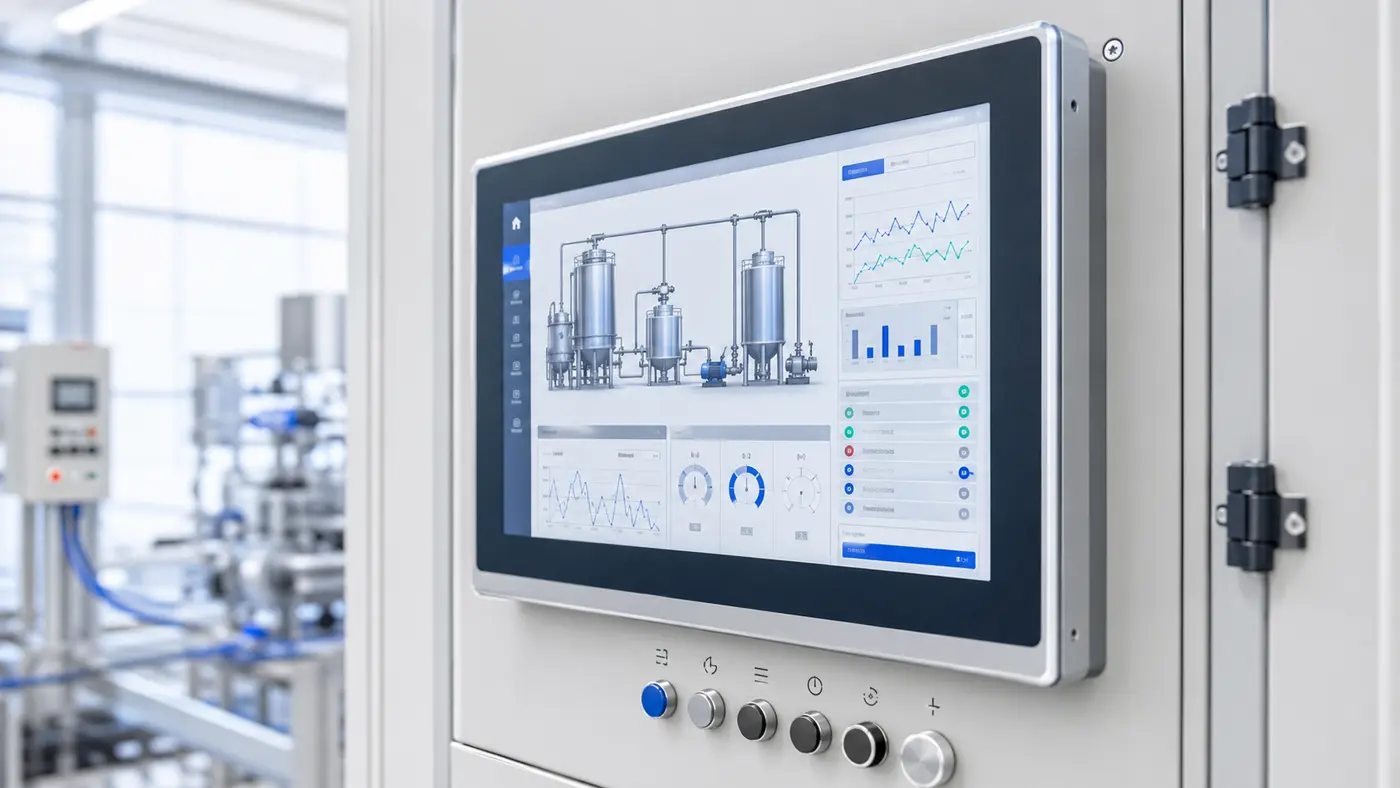
industrial hmi

HMI development for industrial equipment

We design operator interfaces for embedded and industrial systems: screen architecture, interaction logic, device integration and the software layer connecting HMI to equipment.

Industrial HMI touchscreen interface integrated with control electronics

You can start with a practical problem

You do not need to prepare formal engineering terminology before contacting us. A clear business or equipment problem is enough for an initial technical discussion.

What we do

MapUser roles, operating scenarios, alarms and service workflows.
StructureScreen hierarchy, navigation and information priorities.
DesignControls, states, indicators and error presentation.
IntegrateController data model, protocol mapping and commands.
ImplementEmbedded UI on the selected target platform.
ValidateUsability, fault cases and equipment-level behavior.

What the customer receives

The exact deliverable set is agreed before the stage starts so acceptance is based on concrete engineering results rather than activity.

Screen and interaction specificationUI assets and source projectProtocol/data mappingTarget application buildAcceptance scenarios

Technology and implementation

We select the architecture and tools according to interfaces, timing, environment, maintainability and production constraints.

Embedded UITouchscreen interfaces on Linux or MCU-class targets.
Industrial dataController variables, alarms, trends and configuration.
ProtocolsModbus, CAN, Ethernet protocols or proprietary interfaces.
StatesClear normal, warning, fault and service modes.
Service UXCommissioning, diagnostics and maintenance workflows.
Hardware integrationDisplay, touch controller, backlight and enclosure constraints.

HMI development for industrial equipment: engineering approach

Industrial HMI is part of the control system, not a separate graphic layer. Screen states, command confirmation, alarms and service actions must match the controller behavior.

We start from operator tasks and equipment states, then define the data contract between the interface and the controller.

For embedded targets we also consider boot time, resource limits, update strategy and field service.

01

Operator workflows

02

Screen architecture

03

Alarm and status behavior

04

Controller data mapping

05

Embedded implementation

06

Equipment-level verification

Frequently asked questions

Questions that are useful to settle before the initial estimate.

Can you work with our existing controller?

Yes, if we have the protocol or can analyze the interface between the controller and current HMI.

Do you only design screens?

No. We can cover both UI logic and the embedded software/integration layer.

Can you redesign a legacy HMI?

Yes. We can preserve the required process logic while improving structure, readability and maintainability.

Can the HMI run on Embedded Linux?

Yes, this is a common architecture for feature-rich panels.

Do you test on the real equipment?

Where practical, yes. HMI behavior is best validated together with controller states and fault scenarios.

Discuss your engineering task

Send screenshots or a workflow description, display size, target platform and the controller/protocol information.

Useful informationdevice purpose, power, interfaces, operating environment, expected volume, component constraints and target schedule
Customer type