
embedded firmware

Embedded firmware development for microcontrollers

We develop and maintain firmware for MCU-based products: drivers, control logic, industrial protocols, diagnostics, bootloaders, updates and RTOS-based applications.

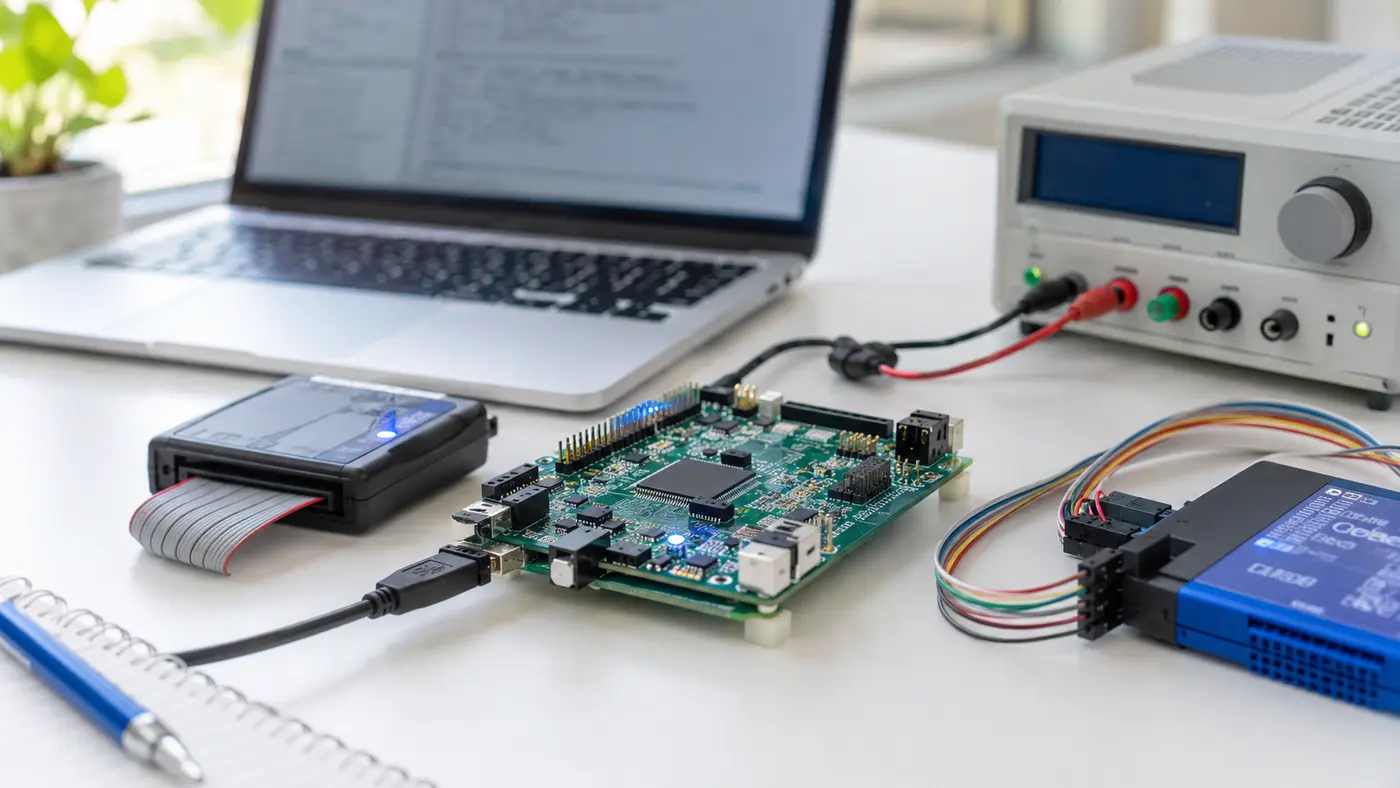
Microcontroller firmware debugging with a programmer and logic analyzer

You can start with a practical problem

You do not need to prepare formal engineering terminology before contacting us. A clear business or equipment problem is enough for an initial technical discussion.

What we do

DefineTiming, safety states, interfaces and diagnostic requirements.
Bring upClock tree, GPIO, power-control signals and basic peripherals.
ImplementDrivers, services, control logic and state machines.
IntegrateProtocols, storage, bootloader, update and production modes.
VerifyTiming, fault handling, communication and long-run behavior.
ReleaseSource code, build configuration, binaries and technical notes.

What the customer receives

The exact deliverable set is agreed before the stage starts so acceptance is based on concrete engineering results rather than activity.

Firmware source repositoryReproducible build configurationProgramming/update imagesInterface and diagnostic descriptionVerification notes

Technology and implementation

We select the architecture and tools according to interfaces, timing, environment, maintainability and production constraints.

MCU platformsSTM32, Microchip, NXP and other common embedded controllers depending on the project.
RTOSFreeRTOS or another suitable RTOS when concurrency and timing justify it.
Bare metalCompact deterministic firmware where an RTOS adds no value.
ProtocolsCAN, Modbus, RS-485, UART, SPI, I2C, Ethernet-related stacks and proprietary protocols.
DiagnosticsLogging, watchdog strategy, error codes and service modes.
UpdateBootloader, firmware update path and rollback strategy where required.

Embedded firmware development for microcontrollers: engineering approach

The firmware architecture is chosen from the device behavior, timing and failure requirements rather than from a preferred framework. Simple products may be cleaner as bare-metal applications; larger systems benefit from an RTOS and explicit task boundaries.

We work close to the hardware: board bring-up, oscilloscope and logic-analyzer measurements, driver debugging and protocol traces are part of firmware development when required.

For existing products we can audit, stabilize or port the codebase while preserving external behavior and interfaces.

01

Board bring-up

02

Peripheral drivers

03

Control logic and state machines

04

RTOS architecture where justified

05

Industrial communications

06

Diagnostics and firmware update

Frequently asked questions

Questions that are useful to settle before the initial estimate.

Can you write firmware for our existing board?

Yes. We need the hardware documentation or a board sample and enough access to bring up and debug the target.

Do you always use an RTOS?

No. We select bare metal or an RTOS based on concurrency, timing, maintainability and safety behavior.

Can you port firmware to another MCU?

Yes, provided the required external behavior and hardware interfaces can be reproduced on the new platform.

Can you debug firmware written by another team?

Yes. We can start with code and hardware review, reproduce the issue and define a stabilization plan.

Do you provide source code?

For custom development the agreed source code and build materials are normally part of the deliverables.

Discuss your engineering task

Send the MCU/board information, current code if available, required interfaces and a short description of the expected device behavior.

Useful informationdevice purpose, power, interfaces, operating environment, expected volume, component constraints and target schedule
Customer type