
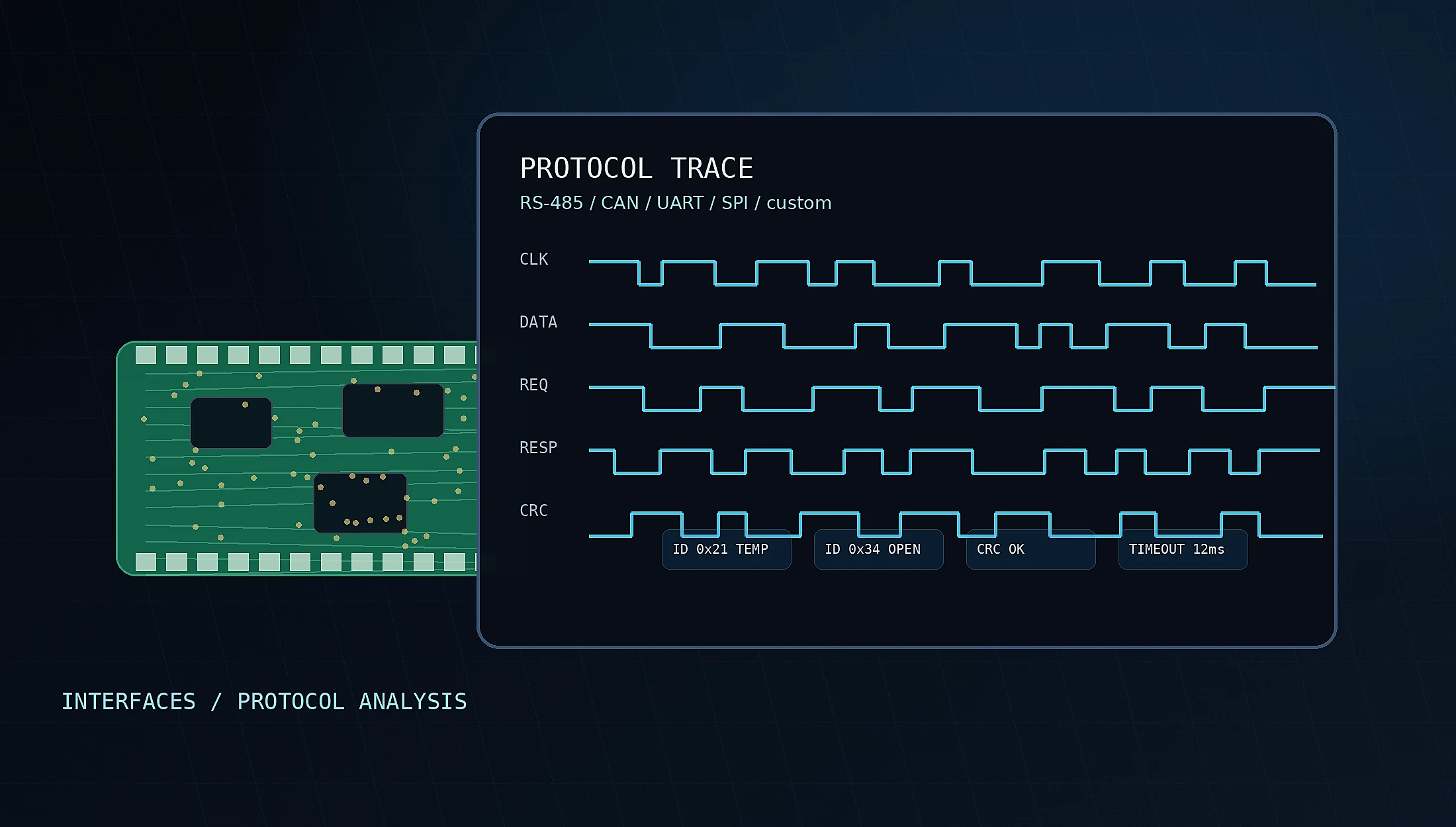
industrial protocol analysis

Industrial and proprietary protocol analysis

We analyze device communications when documentation is missing or incomplete: physical interface, frame structure, commands, responses, timing and error behavior.

Logic and protocol analysis of industrial electronic equipment

You can start with a practical problem

You do not need to prepare formal engineering terminology before contacting us. A clear business or equipment problem is enough for an initial technical discussion.

What we do

CaptureCollect traffic in representative operating scenarios.
CorrelateMatch frames with physical actions, states and measurements.
DecodeIdentify framing, addressing, checksums, commands and data fields.
ProbeGenerate controlled requests when safe and appropriate.
DocumentDescribe message formats, timing and known behavior.
ImplementUse the result in firmware, gateways or compatible devices.

What the customer receives

The exact deliverable set is agreed before the stage starts so acceptance is based on concrete engineering results rather than activity.

Protocol trace setFrame/field descriptionCommand-response mapTiming and error notesImplementation guidance or protocol code where included

Technology and implementation

We select the architecture and tools according to interfaces, timing, environment, maintainability and production constraints.

Physical layersUART/TTL, RS-232, RS-485, CAN and Ethernet-based links depending on the device.
CaptureLogic analyzers, bus interfaces and application-level logging.
CorrelationControlled state changes and side-by-side observation of traffic.
ChecksumsIdentification of common and proprietary validation fields.
TimingPolling cycles, retries, timeouts and asynchronous events.
ImplementationDrivers, protocol libraries or gateways based on the recovered behavior.

Industrial and proprietary protocol analysis: engineering approach

A reliable protocol description requires more than recognizing byte patterns. We correlate traffic with known device states and deliberately vary one condition at a time.

Where active probing could affect equipment safety, analysis begins passively and test boundaries are agreed in advance.

The recovered protocol can then be used for integration, migration or development of a compatible replacement module.

01

Traffic capture

02

Frame structure recovery

03

Command/response mapping

04

Timing analysis

05

Error behavior

06

Implementation support

Frequently asked questions

Questions that are useful to settle before the initial estimate.

Can you analyze proprietary RS-485 traffic?

Yes. RS-485 is the physical layer; the application protocol can often be reconstructed from traffic and controlled experiments.

Do you need two working devices?

Not always. A working system that generates representative traffic is usually the most useful starting point.

Can you implement the protocol afterwards?

Yes. Firmware or gateway implementation can be a separate follow-on stage.

Can CAN traffic be analyzed?

Yes, including arbitration IDs, payload patterns and higher-level behavior where enough operating scenarios are available.

Can you guarantee every command will be found?

The completeness depends on how many device states and scenarios can be exercised. We document the observed coverage and remaining unknowns.

Discuss your engineering task

Send the interface type, device models, available traces or access to the equipment, and describe what integration or replacement goal you need to achieve.

Useful informationdevice purpose, power, interfaces, operating environment, expected volume, component constraints and target schedule
Customer type