
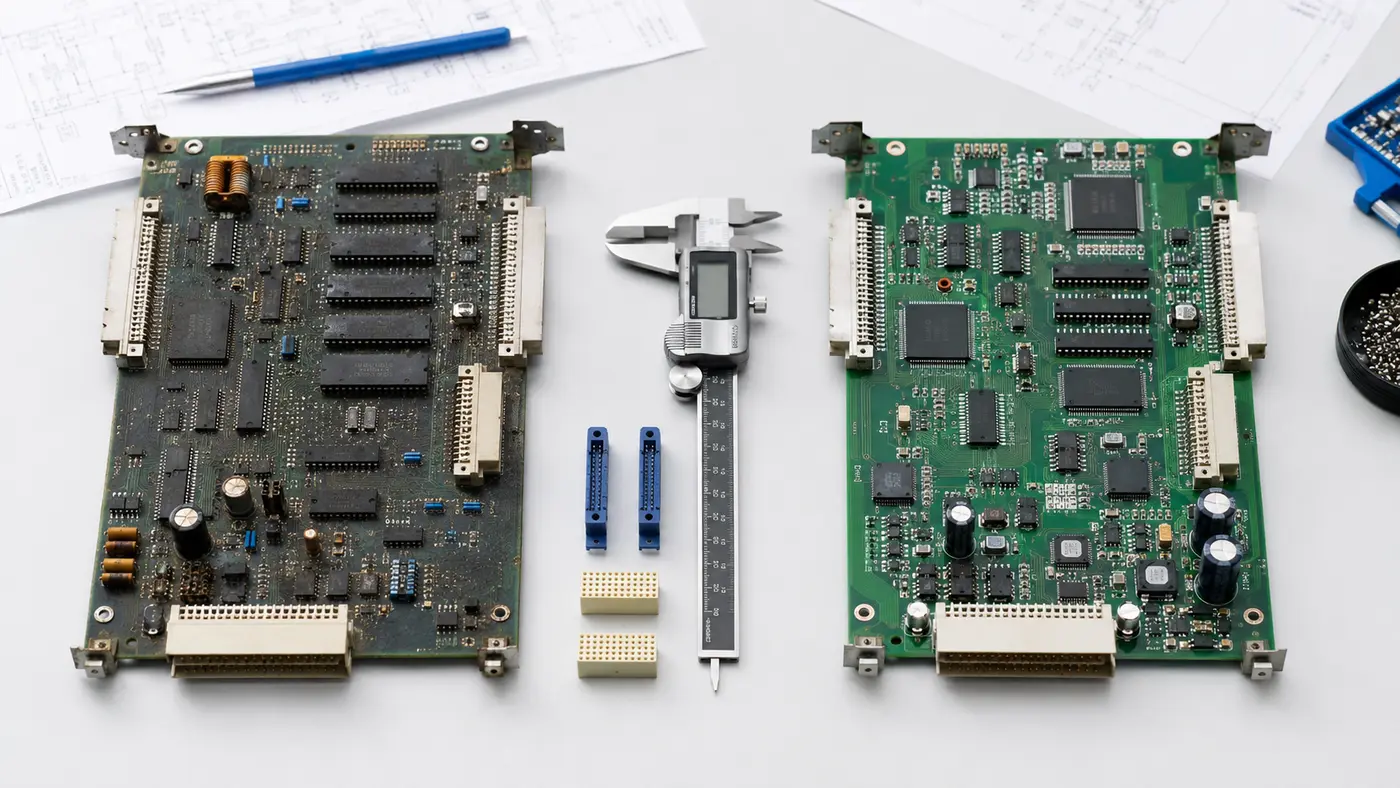
Compatible PCB replacement development from an existing sample
We develop a functional replacement for a discontinued, unavailable or uneconomical board while preserving the interfaces and system behavior that the equipment actually needs.

You can start with a practical problem
You do not need to prepare formal engineering terminology before contacting us. A clear business or equipment problem is enough for an initial technical discussion.
What the customer receives
The exact deliverable set is agreed before the stage starts so acceptance is based on concrete engineering results rather than activity.
Technology and implementation
We select the architecture and tools according to interfaces, timing, environment, maintainability and production constraints.
Compatible PCB replacement development from an existing sample: engineering approach
The target is normally functional compatibility, not a literal copy of every legacy design decision. We identify the properties that the host equipment depends on and reproduce those deliberately.
If documentation is missing, reverse engineering is performed first. The replacement is then designed on a current component base with the agreed mechanical and electrical constraints.
The acceptance criteria are defined before detailed design so compatibility can be verified objectively.
Original-board characterization
Interface and behavior specification
New schematic and PCB
Firmware where required
Compatibility testing
Production documentation
Frequently asked questions
Questions that are useful to settle before the initial estimate.
Do you need a working original?
A working sample is strongly preferred because it provides a behavioral reference. A non-working sample can still be useful for destructive analysis.
Can you develop the replacement without extracting original firmware?
Often yes. If external behavior and protocols are known or can be measured, the software can be implemented independently.
Will the new board be an exact copy?
Usually not. The goal is a documented, manufacturable and compatible product, not duplication of unnecessary legacy internals.
Can connectors and dimensions be preserved?
Yes, when drop-in mechanical compatibility is part of the requirements.
How do you validate compatibility?
We agree the electrical and functional criteria, then compare the prototype on a bench and, where possible, inside the target equipment.
Discuss your engineering task
Send photos, dimensions, connector information, equipment context and any sample or manual available for the original module.
